How to Become a Full-stack Developer in 2026
If you’ve read the front-end post and the back-end post and thought “I want both” or “I want to have my cake and eat it.” - this post is just for you. It’s also for anyone who already knows what front-end and back-end development are and has independently arrived at the same conclusion: why pick one when you can own the whole thing?
Full-stack development is one of the most searched terms in tech, one of the most misunderstood career paths, and - when approached correctly - one of the most rewarding things you can build toward as a developer. This post covers what full-stack actually means beyond the buzzword, an honest look at what the path demands, a complete roadmap from zero to hero who can deploy applications, and a real conversation about what specialization looks like once you get there.
No shortcuts. No “learn full-stack in 30 days.” Just the full picture.
The Honest Reality
Let’s start with what nobody in a YouTube thumbnail will tell you.
Full-stack development means being competent on both the front-end and the back-end - building the user interface, wiring it to a server, connecting that server to a database, handling authentication, deploying the whole thing, and maintaining it. That is a significant amount of ground to cover, and it takes longer to reach a job-ready level than either discipline does alone.
The feedback loop is also more complex. Front-end gives you immediate visual feedback - you write code and see the result. And then you get to back-end, which gives you a terminal and a JSON response. Full-stack means you need to be comfortable with both simultaneously - debugging across layers, tracing a bug that might live in the UI, the API, the database, or somewhere in between.
None of that is a reason not to pursue it. It’s a reason to pursue it with accurate expectations rather than optimistic ones.
Here’s what makes the path worth it: full-stack developers can build complete products independently. They can take an idea from a blank screen to a deployed, working application without needing to hand off to someone else. That capability is rare, genuinely valuable, and increasingly in demand in a market where small teams need people who can move across the entire stack without slowing down.
The developers who thrive in full-stack are the ones who treat both sides with equal seriousness - not the ones who learn just enough back-end to call themselves full-stack, or who rush through the front-end to get to the “real” programming. The goal is competence on both sides and mastery of at least one. More on that shortly.
Generalist vs Specialist - The Real Conversation
This is the question that comes up every time full-stack development is discussed, and it deserves a direct answer rather than a diplomatic dodge.
At junior and mid levels, full-stack developers are widely hired and highly valued. Startups in particular - which make up the majority of the job market - need people who can own features end to end without requiring a team of specialists. A small engineering team can’t afford to have a dedicated front-end developer, a dedicated back-end developer, and a dedicated DevOps engineer for every feature. They need people who can move across the stack.
At senior levels, the picture shifts. Large companies - the ones with the highest compensation and the most complex engineering problems - tend to want depth. A senior front-end engineer at a major tech company is expected to have a level of expertise in performance optimization, browser rendering, and accessibility that a generalist who split their time between both sides simply won’t have developed. The same applies on the back-end - distributed systems, database internals, and security at scale are deep disciplines.
This is sometimes presented as an argument against full-stack development. It isn’t.
Here’s the more accurate framing: full-stack is the path, specialization is the destination. You start by building competence across both sides because that’s what makes you employable, productive, and capable of building real things. As you work and grow, you’ll naturally gravitate toward one side - you’ll find yourself going deeper on the front-end because you love the craft of UI, or deeper on the back-end because systems design is where your mind lights up. You don’t choose that direction; it chooses you through the work.
The full-stack foundation means you understand both sides well enough to be dangerous on either, communicate fluently with specialists, and architect systems that hold together from database to interface. The specialization that comes later makes you exceptional at one of them. That combination - broad foundation, deep expertise - is what separates the best senior developers from the rest.
So don’t let the “generalist ceiling” argument discourage you. Let it motivate you to build the full foundation first, and then go deep on the side that earns your obsession. Be a master of your craft - both of them.
Jobs, Salaries & Demand in 2026
The Job Market
Full-stack developers are among the most consistently hired profiles in the tech industry. The demand is particularly strong in three areas: startups building new products, agencies delivering client work, and independent developers shipping their own products. In all three contexts, the ability to own the entire feature - from database schema to pixel-perfect UI - is directly tied to output speed and product quality.
Larger companies hire full-stack developers too, particularly at junior and mid levels where cross-functional capability accelerates onboarding and contribution. The expectation at these companies is often that full-stack developers eventually deepen into one area, but the generalist capability is valued on the way there.
In-demand skills in 2026:
- React - still the dominant front-end framework across the market
- TypeScript - increasingly expected on both front-end and back-end
- Java with Spring Boot - dominant in enterprise and fintech
- Node.js - widely used in startups and JavaScript-heavy full-stack teams
- PostgreSQL and database design - non-negotiable at every level
- REST API design and authentication (JWT, OAuth 2.0)
- Docker and basic DevOps - expected at mid-level and above
- Cloud platforms (AWS, GCP, Azure) - increasingly standard, not just a bonus
Salary Ranges (Approximate, 2026)
| Level | Nigeria (NGN/year) | Global Remote (USD/year) |
|---|---|---|
| Junior | ₦2.5M – ₦5M | $45,000 – $75,000 |
| Mid-level | ₦5M – ₦10M | $75,000 – $130,000 |
| Senior | ₦10M – ₦22M+ | $130,000 – $220,000+ |
Disclaimer: These are directional figures - actual pay varies by company size, industry, location, and your specific skill set. Full-stack developers at product companies and remote roles with international clients tend to sit at the higher end of these ranges.
Career Paths from Full-stack
Full-stack opens more doors than either discipline does alone:
- Product Engineering
- Technical Co-founder
- Solutions Architecture
- DevOps Engineering
- Platform Engineering, and increasingly, AI application development, where the ability to wire a model to a front-end and a database is a direct and immediate advantage.
The Stack Combinations
Before you start the roadmap, you need to choose a stack. Here are the three most realistic combinations for a full-stack developer in 2026, with honest assessments of each.
Combination 1 - React + Spring Boot
| Front-end: React | Back-end: Java with Spring Boot |
The most enterprise-relevant combination. React dominates the front-end job market and Spring Boot dominates back-end in fintech, enterprise, and large-scale systems. This combination has the steepest learning curve - Java’s verbosity and Spring Boot’s configuration overhead are real - but it produces the deepest understanding of full-stack architecture. The patterns you learn here transfer directly to every other combination.
Best for: developers targeting enterprise roles, fintech, or large-scale systems. Also the best combination for developers who want to deeply understand how full-stack systems are architected before working with lighter alternatives.
Combination 2 - React + Django
| Front-end: React | Back-end: Python with Django |
A strong combination for developers interested in Python, data-adjacent work, or AI infrastructure. Django is opinionated, batteries-included, and fast to work with once you know Python. The gap between front-end and back-end complexity is narrower here than in Combination 1, which makes this a more approachable starting point for some learners.
Best for: developers interested in Python, data engineering, or AI-adjacent back-end work.
Combination 3 - React + Node.js
| Front-end: React | Back-end: JavaScript with Express/Node.js |
The single-language stack. React on the front-end and Node.js on the back-end means you’re writing JavaScript throughout - which reduces context switching and makes the early learning stages more manageable. Express is minimal by design, which means less configuration overhead early on. The trade-off is that this combination teaches less about how back-end systems work under the hood than the other two.
Best for: developers already comfortable with JavaScript who want to move fast, or those targeting startup and agency environments where Node.js is prevalent.
The Recommendation
Start with React + Spring Boot.
Not because it’s the easiest - it surely isn’t - but because it’s the combination that teaches you the most. The patterns you learn in Spring Boot are the same patterns that underpin Django and Node.js, just more explicitly exposed. Once you’ve built a full-stack application with React and Spring Boot, picking up a lighter back-end framework is a matter of weeks, not months.
This recommendation is also consistent with what the front-end post and the back-end post already recommended independently. If you’ve been following the blog’s roadmap, you’re already building toward this combination - this post just connects the two sides into one coherent path.
The Full Roadmap
The stages below are sequential. The most common mistake full-stack beginners make is trying to learn both sides at the same time from day one. Don’t. Learn one side to a solid foundation first, then cross over. The roadmap reflects this.
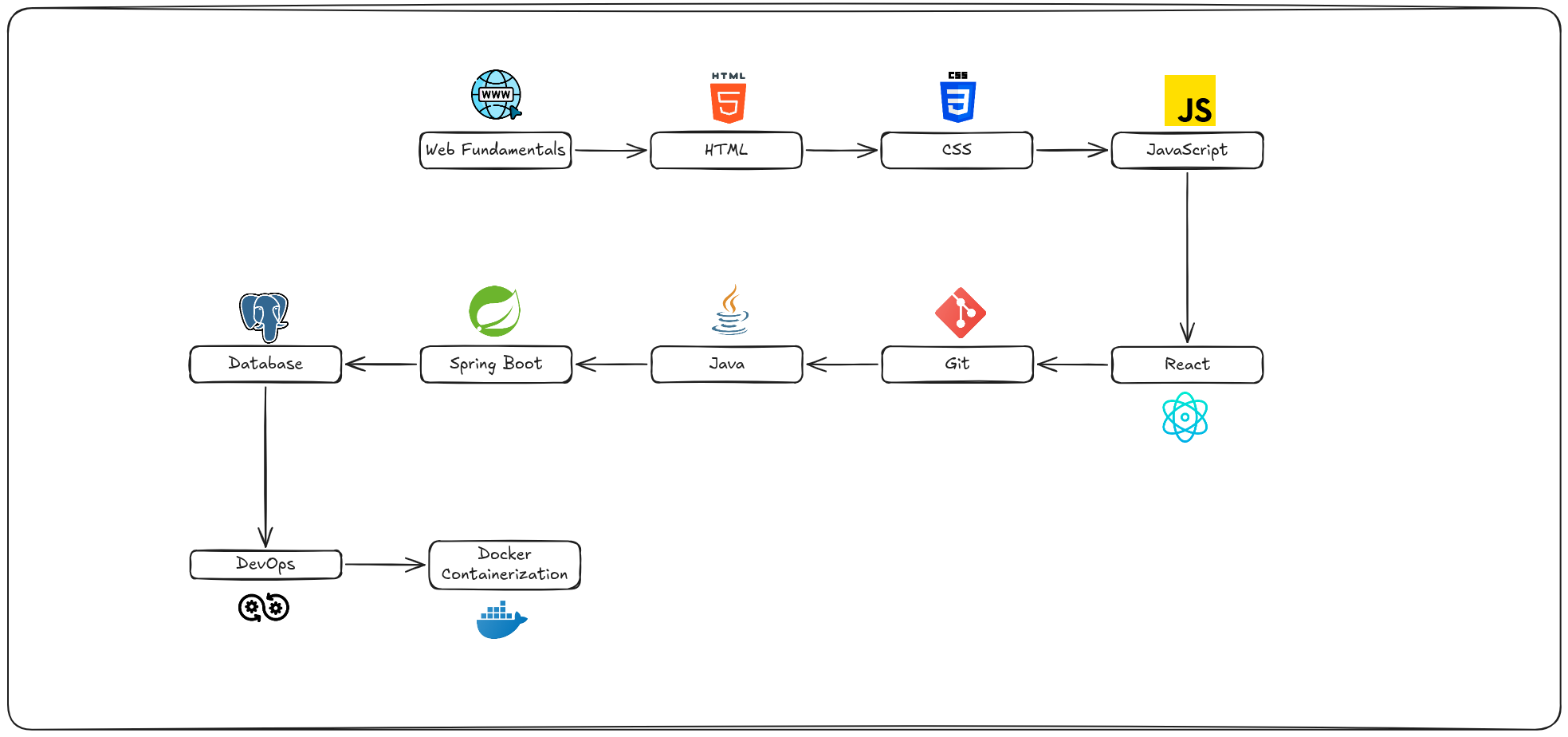
Stage 1 - Front-end Foundation (4-6 months)
Start here. Before Spring Boot, before databases, before any of that - build a solid front-end foundation first.
HTML (2-4 weeks): Document structure, semantic elements, forms. You’re ready to move on when you can build a multi-page site from scratch without looking anything up.
CSS (4-8 weeks): The box model, Flexbox, CSS Grid, responsiveness, and media queries. You’re ready to move on when you can take a design you’ve seen online and rebuild it in CSS without the layout falling apart.
JavaScript (8-12 weeks): Variables, data types, conditionals, loops, functions, the DOM, events, and asynchronous JavaScript - fetch, promises, async/await. This is the most important stage of the front-end foundation. You’re ready to move on when you can build an app that fetches data from a public API and displays it on the page, without following a tutorial.
React (8-12 weeks): Components, props, state, hooks, and fetching data from an API. You’re ready to move on when you can build a multi-component React app that manages state and communicates with a back-end.
Stage 2 - Back-end Foundation (6-10 months)
Once your front-end foundation is solid, cross over. Don’t rush this transition - “solid” means you’ve built several projects and can work without tutorials, not just that you’ve finished a course.
Java Fundamentals (4-6 weeks): Variables, data types, control flow, methods, arrays, and how Java programs are structured. You’re ready to move on when you can write Java programs that read input, apply logic, and produce output without looking anything up.
OOP & Design Patterns (4-6 weeks): Classes, objects, inheritance, encapsulation, polymorphism, interfaces, and the design patterns Spring Boot uses heavily - Singleton, Factory, Dependency Injection. You’re ready to move on when you can design a Java application using multiple classes and interfaces and explain why you structured it the way you did.
Spring Boot (8-12 weeks): Spring MVC, Dependency Injection, Spring Data JPA, Spring Security, and exception handling. Build things throughout this stage - a task manager API, a user authentication system, a blog post CRUD API. You’re ready to move on when you can build a REST API with Spring Boot that connects to a database, handles authentication, and returns proper responses without following a tutorial.
Databases (6-8 weeks, alongside Spring Boot): PostgreSQL and SQL - CRUD operations (INSERT, SELECT, UPDATE, DELETE), joins, and indexes. Database design - tables, relationships, normalization. MongoDB as a working understanding of NoSQL. You’re ready to move on when you can design a database schema and connect it to a Spring Boot application.
APIs & Authentication (4-6 weeks): REST conventions, HTTP methods and status codes, JWT authentication, and OAuth 2.0. You’re ready to move on when you can build a fully authenticated REST API and explain how every part of it works.
Stage 3 - Connecting the Stack (6-8 weeks)
This is where full-stack development actually begins - and where most tutorials fall short.
Building a front-end and building a back-end are separate skills. Connecting them into one coherent, working application is a third skill that only develops through doing it. This stage is about building complete full-stack projects where you own every layer: the React front-end, the Spring Boot API, the PostgreSQL database, and the connection between all three.
Project ideas for this stage:
- A task management app - user authentication, task creation, status updates, persistent storage
- A personal finance tracker - CRUD operations, data visualization on the front-end, secure back-end
- A blog platform - posts, comments, user profiles, image uploads
The specific project doesn’t matter. What matters is that you build something non-trivial, encounter real problems at the seams between front-end and back-end, and solve them yourself. CORS (Cross-Origin Resource Sharing) configuration, handling loading and error states in React, structuring API responses that the front-end can consume cleanly - these are the problems that turn a developer who can build both sides separately into a developer who can build them together.
You’re ready to move on when: You’ve built at least two complete full-stack projects from scratch - no tutorial, no hand-holding - and can deploy them to a live URL.
Stage 4 - Deployment & DevOps Basics (4-6 weeks)
A full-stack application that only runs on your machine isn’t finished. This stage covers the basics of getting your work in front of real users.
Git workflow: Branching, pull requests, and managing code across front-end and back-end repositories. Not just committing - structured, professional version control.
Docker: Containerizing your application so it runs consistently across environments. You don’t need to go deep here - understand what Docker does, why teams use it, and how to write a basic Dockerfile and docker-compose setup for a full-stack application.
Cloud deployment: Deploy a full-stack application to a real server. AWS is the recommendation - start with EC2 for your back-end, S3 for static front-end hosting or file storage, and RDS for your database. Alternatively, platforms like Railway or Render offer simpler deployment for beginners and are worth knowing about.
Environment management: Environment variables, secrets management, and the difference between development and production configurations. Every full-stack application has secrets that should never be in your code - learn to handle them properly from the start.
You’re ready to move on when: You have at least one full-stack application live on the internet, accessible via a real URL, with a proper deployment pipeline.
Stage 5 - Specialization (Ongoing)
You’re a full-stack developer. Now the question is: which side do you go deeper on?
This stage doesn’t have a fixed timeline because it unfolds through the work. As you build more, one side will start demanding more of your attention - not because you decided it would, but because you find yourself going deeper on problems there, reading more about it, caring more about getting it right.
Pay attention to that signal. It’s telling you where your mastery lives.
If it’s the front-end: go deeper on performance optimization, accessibility, animation, design systems, and React architecture patterns. TypeScript if you haven’t already. Eventually, the intersection of engineering and design is where the best front-end developers live.
If it’s the back-end: go deeper on distributed systems, database internals, system design, security at scale, and cloud architecture. The back-end ceiling is extremely high - there’s always more to understand about how systems work at scale.
Whichever side you deepen into, keep the other one maintained. The value of being a full-stack developer isn’t just that you can build complete applications - it’s that you can have the full conversation. You understand what the front-end needs from the API because you’ve built front-ends. You understand what the back-end is doing with the data because you’ve built back-ends. That holistic perspective is what makes full-stack developers uniquely effective, and it’s worth protecting.
When You’re Ready to Specialize
There’s no fixed point at which specialization begins - it emerges from the work. But there are signals worth watching for.
You’re ready to start deepening when:
- You’ve shipped at least two or three complete full-stack applications end to end
- You can debug across all layers without getting lost - front-end, API, database
- You notice that problems on one side consistently interest you more than problems on the other
- You find yourself reading about one side outside of project requirements - not because you have to, but because you want to
When those signals appear, lean into them. Start taking on projects/roles that give you more of the problems you find interesting. Read more deeply in that area. Build things that are specifically challenging on that side.
The goal isn’t to abandon the other side - it’s to develop a dominant area of expertise while keeping the full-stack foundation intact. A senior front-end engineer who understands back-end systems is far more valuable than one who doesn’t. A senior back-end engineer who can read and write React is far more effective than one who treats the front-end as a black box.
Be a specialist with full-stack context. That’s the target.
What Full-stack Development Looks Like in Practice
Unlike front-end and back-end in isolation, full-stack development means you own the entire feature lifecycle. Here’s what that actually looks like.
Owning a Feature End to End
When a full-stack developer picks up a feature - say, “add a user notification system” - they’re responsible for all of it. That means designing the database schema to store notifications, writing the back-end logic to generate and retrieve them, building the API endpoints the front-end will call, implementing the React components that display them, handling loading and error states, and ensuring the whole thing is effective and secure.
No handoff. No waiting for someone else to finish their part. The full-stack developer carries the feature from the first database migration to the last pixel.
Thinking Across Layers
Full-stack developers think differently from specialists because they have to hold the entire system in their head simultaneously. When a page is loading slowly, they’re asking: is this a front-end rendering issue, a slow API response, or a database query that needs an index? When a feature feels brittle, they’re asking: is the problem in the component logic, the API contract, or the data model?
This cross-layer thinking is a skill that takes time to develop but makes problem-solving significantly more effective. Specialists are often constrained by the boundaries of their discipline - full-stack developers are not.
The Communication Advantage
Working with a team of specialists, a full-stack developer can have the full conversation. They can discuss database design with the back-end team without losing context, review a React component with the front-end team without needing things explained, and talk to a designer about what’s technically feasible without oversimplifying. That communication fluency has real value on any team, at any level… and it feels good too.
Tools You’ll Work With
Full-stack development combines the toolsets of both disciplines. You’ll pick these up progressively.
Front-end:
- VS Code - standard editor for front-end work, with extensions for React, TypeScript, and Prettier
- Browser DevTools - inspecting elements, debugging JavaScript, analysing network requests and API responses
- npm / Yarn - package management for JavaScript dependencies
- Vite - modern front-end build tool, fast and straightforward
Back-end:
- IntelliJ IDEA - standard IDE for Java and Spring Boot development
- Postman - testing API endpoints without a front-end, inspecting responses, debugging back-end behaviour
- PostgreSQL + pgAdmin - your primary database and the GUI tool for managing it visually
Full-stack & DevOps:
- Git & GitHub - version control across both sides of the stack. If you’ve been through the Linux post or the Bash post, you’ve already started here
- Docker - containerizing your application for consistent deployment across environments
- AWS - cloud hosting for production applications. EC2, S3, and RDS are the starting points
- Railway / Render - simpler deployment platforms for getting applications live quickly while you’re learning
- The terminal - full-stack developers use it constantly. Running servers, querying databases, managing deployments - all of it happens here
Resources Worth Your Time
Front-end
- MDN Web Docs - the definitive reference for HTML, CSS, and JavaScript. Bookmark it and use it constantly.
- The Odin Project - free, project-based curriculum covering the full front-end stack. One of the best structured learning paths available.
- javascript.info - the best free JavaScript resource available. Covers fundamentals through advanced asynchronous patterns.
- The official React docs - completely rewritten in 2023 and genuinely excellent. Start here for React.
Back-end
- dev.java - Official Java Learning Path - the official Oracle resource for Java fundamentals.
- Baeldung - the most comprehensive Java and Spring Boot resource on the internet. Use it as a reference throughout the back-end stages.
- PostgreSQL Tutorial - clean, well-structured introduction to PostgreSQL and SQL.
- Spring official guides - short, focused guides for specific Spring Boot tasks.
Full-stack & Practice
- Frontend Mentor - real design mockups to build from scratch. Use this throughout the front-end stages.
- roadmap.sh - Full-stack Roadmap - a comprehensive visual map of the full-stack ecosystem. Useful for understanding the full landscape beyond this roadmap.
Common Mistakes
-
Learning both sides simultaneously from day one: This is the most common and most damaging mistake. Trying to learn React and Spring Boot at the same time without a foundation in either produces surface-level understanding of both. The roadmap above is sequential for a reason - finish one side before crossing to the other.
-
Calling yourself full-stack too early: There’s a version of “full-stack” that means “I did a CRUD tutorial in Node.js and can make a div centred.” That’s more like pseudo-stack, not full-stack - and presenting yourself as one before you genuinely are does more damage than good - to your learning, to your credibility, and to your ability to grow. The bar is: can you build and deploy a complete application without help? Until the answer is yes, keep building. And even if the answer is yes, keep building.
-
Treating one side as less important: The most common version of this is back-end developers who write front-end code they’re embarrassed by, or front-end developers who write back-end code they can’t explain. Both sides deserve genuine attention. If you treat one as a box to tick, it will show in your work and in interviews.
-
Skipping deployment: An application that only runs locally isn’t finished. Deployment is where full-stack development completes its loop - and it’s where a lot of learners stop because it feels intimidating. Push through it. Getting your first application live on a real URL is one of the most satisfying moments in the learning process, and the skills you build there are directly applicable to every project after it.
-
Never specializing: The flip side of trying to do everything is never going deep on anything. Full-stack is the foundation, not the destination. The developers who reach the highest levels are the ones who built the broad base and then went deep. Know when to start that deepening process and commit to it.
Frequently Asked Questions
Front-end first. The feedback loop is immediate and visual - you write code and see the result on screen. That immediacy makes the early learning stages more engaging and easier to sustain. Back-end is more abstract; starting there without a foundation makes the ramp-up significantly harder. The roadmap above reflects this - front-end foundation first, back-end foundation second, connecting the two third.
Following this roadmap with consistent daily practice, most people reach a job-ready level in 18 to 30 months. That's a wide range because the pace of learning matters far more than the total time, and full-stack covers significantly more ground than either discipline alone. The developers who get there fastest are the ones who build constantly - not the ones who study the most.
Full-stack is worth it - but not because it replaces specialization. It's worth it because it makes you a more capable developer, a more effective communicator, and someone who can build complete products independently. The specialization comes later and makes the full-stack foundation more valuable, not less. Think of it as building the widest possible base before going deep, rather than choosing between wide and deep.
Yes. Full-stack development is portfolio-driven. What matters is what you can build and demonstrate. A GitHub profile with complete, deployed full-stack applications will open more doors than most degrees. The bar is higher than either discipline alone because employers expect competence on both sides - but the path to demonstrating that competence is the same: build things, deploy them, and be able to explain every decision you made.
"Software engineer" is a broader title that can refer to any developer regardless of specialization - front-end, back-end, full-stack, mobile, systems, and so on. "Full-stack developer" is a specific description of someone who works across both the front-end and back-end of web applications. In practice, many job postings use the terms interchangeably, and many full-stack developers carry the title "software engineer" at their companies. The title matters less than the skills.
At junior and mid levels, full-stack developers generally earn comparable to or slightly above specialists because the breadth of capability is valued. At senior levels, deep specialists at large companies can command higher compensation than generalists - but this isn't a rule, it's a tendency at a specific type of company. Full-stack developers at product companies, startups, and in senior individual contributor roles frequently earn at or above specialist rates. The salary ceiling conversation is real but often overstated.
Where to Go From Here
You’ve got the full picture: what full-stack development actually demands, an honest take on the generalist vs specialist question, the stack combinations and why React + Spring Boot is the recommendation, and a complete roadmap from front-end foundation to deployment and specialization.
The next step is the same one it always is - start. If you haven’t started the front-end foundation yet, that’s where to begin. HTML, a text editor, a browser. If you’ve already got front-end fundamentals and you’re ready to cross over to the back-end, the back-end post is your next stop. If you’re somewhere in the middle, keep building - the connecting-the-stack stage only makes sense once both foundations are solid.
If you’re not set up on Linux yet, the Windows to Linux guide covers everything you need. And if the terminal still feels unfamiliar, the Bash scripting post is worth your time - full-stack developers live in the terminal more than almost anyone.
For questions, project feedback, or just to share what you’re building - join the community via the links in the footer.