How to Get into Cybersecurity in 2026
Cybersecurity is everywhere and nowhere at the same time. Everyone talks about it - news articles, company breaches, government warnings - but very few people can tell you what a cybersecurity professional actually does on a Tuesday afternoon, or more importantly - what it takes to become one.
This post fixes that. It covers what cybersecurity actually is, why the world needs more people in it, every major career path the field opens, and a complete roadmap that takes you from zero to job-ready in 2026. Whether you’re coming from the front-end or back-end side of the blog, or landing here with a completely fresh background - this post is the starting point.
If you already know cybersecurity is your path and ethical hacking specifically is where you want to go, stay until the end - there’s a post coming that goes deep on exactly that.
Let’s get into it.
What is Cybersecurity?
Cybersecurity is the practice of protecting systems, networks, applications, and data from digital attacks, unauthorised access, damage, and theft.
That’s the textbook definition. Here’s the more honest one: cybersecurity is the ongoing, never-finished work of staying ahead of people who are actively trying to break into things that aren’t theirs. It’s a discipline, a mindset, and - as of 2026 - one of the most critical professional fields on the planet.
The scope is wider than most people realize. Cybersecurity covers:
- Network security - protecting the infrastructure that data travels through
- Application security - finding and fixing vulnerabilities in software before attackers do
- Endpoint security - protecting individual devices (laptops, phones, servers) from compromise
- Cloud security - securing infrastructure and data in cloud environments
- Identity and access management - controlling who can access what, and ensuring they’re who they say they are
- Incident response - detecting breaches when they happen and containing the damage
- Governance, Risk & Compliance (GRC) - the policies, frameworks, and audits that keep organizations legally and operationally secure
The Hollywood version - a lone hacker typing furiously in a dark room - is the least representative version of the field. Most cybersecurity work is methodical, process-driven, and deeply collaborative. The exciting parts exist, but they exist alongside a lot of careful, systematic work that doesn’t make it into films.
Why Cybersecurity Matters
The Stakes
In 2024, the average cost of a data breach globally was $4.88 million - the highest recorded figure to date. That number doesn’t exactly capture the full picture. Breaches destroy customer trust, trigger regulatory fines, expose sensitive personal data, and in critical infrastructure - power grids, hospitals, financial systems - can have consequences that go far beyond financial loss.
The attacks are getting more sophisticated, more frequent, and more targeted. Ransomware has evolved from a nuisance into an industry. Supply chain attacks - compromising widely-used software to reach downstream targets - have become a preferred vector for nation-state actors. AI is being used to generate more convincing phishing campaigns at a scale that wasn’t possible before.
Every company that has software has an attack surface. Every organization that stores data is a potential target. And the number of people qualified to defend those systems is nowhere near the number needed.
The Opportunity
That gap between attackers and defenders is where the career opportunity lives.
The global cybersecurity workforce shortage is estimated at over 4 million unfilled positions as of 2024 - and that number grows every year. Companies aren’t struggling to find cybersecurity professionals because the work isn’t valued. They’re struggling because there aren’t enough people with the skills to do it.
This is a field where demand consistently outpaces supply, where remote work is widely available, where career progression can be rapid for people who build genuine skills, and where the work carries real-world consequence. You’re not optimizing ad performance or redesigning a checkout flow - you’re protecting systems that people depend on.
That’s a meaningful place to work.
The Career Paths
Cybersecurity is not a single job. It’s a field with several distinct disciplines, each requiring a different mindset and skillset. Here’s the map.
Ethical Hacking / Penetration Testing
Penetration testers - pen testers - are paid to attack systems with permission in order to find vulnerabilities before real attackers do. This is the offensive side of security: thinking like an attacker, exploiting weaknesses in applications, networks, and infrastructure, and writing detailed reports on what you found and how to fix it.
This is the path most people imagine when they think of cybersecurity. It’s also the one covered in depth in the ethical hacking post coming up next.
Personality fit: Curious, persistent, enjoys finding creative ways around things, comfortable with ambiguity.
Blue Team / Defence
Blue team professionals protect systems in real time. This includes Security Operations Centre (SOC) analysts who monitor alerts and investigate threats, incident responders who contain and remediate active breaches, and threat hunters who proactively look for indicators of compromise before alerts fire.
This path is less glamorous than ethical hacking in popular perception but is where the majority of cybersecurity jobs actually live - and where the day-to-day stakes are most immediate.
Personality fit: Methodical, calm under pressure, good at pattern recognition, comfortable with process-heavy work.
Security Engineering
Security engineers build secure systems from the ground up. They design authentication systems, implement encryption, integrate security tooling into development pipelines (DevSecOps), and ensure that security is a property of the architecture rather than something bolted on afterward.
This path sits at the intersection of software engineering and security, and typically requires the strongest programming background of the major cybersecurity paths.
Personality fit: Enjoys building systems, thinks in abstractions, interested in how security properties are enforced at a technical level.
Digital Forensics & Incident Response (DFIR)
DFIR professionals investigate what happened after a breach. They recover deleted files, analyse malware, reconstruct attack timelines, collect legally admissible evidence, and produce reports that can be used in legal proceedings or regulatory investigations.
This is a deeply technical path that sits at the intersection of cybersecurity and investigation. It requires both technical depth and meticulous documentation discipline.
Personality fit: Detail-oriented, patient, interested in understanding exactly how things broke and why.
Governance, Risk & Compliance (GRC)
GRC professionals manage the policy, process, and regulatory side of security. They conduct risk assessments, develop security policies, ensure compliance with frameworks like ISO 27001, NIST, GDPR, and PCI-DSS, and communicate security posture to executive and board-level stakeholders.
This path requires less deep technical skill than the others but demands strong communication, analytical thinking, and a thorough understanding of how security frameworks are structured and applied.
Personality fit: Enjoys structure and process, strong communicator, interested in how security intersects with business and law.
Jobs, Salaries & Demand in 2026
The Job Market
Cybersecurity hiring is one of the most resilient in the tech industry. Where other tech hiring has been cyclical - booming in some years, contracting in others - cybersecurity demand has remained consistently elevated because the threat landscape doesn’t take breaks.
Entry-level roles are more accessible than in many other tech disciplines because organizations need volume: SOC analysts, junior pen testers, and GRC associates are hired in significant numbers. Senior roles command among the highest compensation in the technology sector.
In-demand skills in 2026:
- Network fundamentals (TCP/IP, DNS, HTTP/S, firewalls, VPNs)
- Linux proficiency - non-negotiable at every level
- Python scripting for automation and tool development
- Cloud security (AWS, Azure, GCP) - increasingly required at mid-level
- SIEM tools (Splunk, Microsoft Sentinel) - core to blue team and SOC roles
- Application security - web vulnerability assessment, OWASP Top 10
- Threat intelligence and threat hunting
- Incident response and forensics
- Security certifications (Security+, CEH, OSCP) - carry genuine weight in this field
Salary Ranges (Approximate, 2026)
| Level | Nigeria (NGN/year) | Global Remote (USD/year) |
|---|---|---|
| Junior | ₦1.5M – ₦3.5M | $45,000 – $75,000 |
| Mid-level | ₦3.5M – ₦9M | $75,000 – $130,000 |
| Senior | ₦9M – ₦22M+ | $130,000 – $220,000+ |
Disclaimer: These are directional figures - actual pay varies significantly by specialization, company size, industry, and location. Penetration testers and security engineers tend to sit at the higher end; GRC and junior SOC roles tend to sit at the lower end. Remote roles with international clients can pay significantly above local market rates.
Career Paths and Progression
Cybersecurity offers genuine upward mobility. A SOC analyst can grow into a threat hunter, then an incident response lead, then a security manager. A junior pen tester can progress to senior consultant, then practice lead, then CISO-track. A GRC associate can move into risk management, then security governance, then executive advisory roles.
Beyond specialization, cybersecurity opens adjacent paths: security consulting, threat intelligence, product security at tech companies, and increasingly - AI security, which is an emerging field with no shortage of unsolved problems.
Your First Lab
Reading about cybersecurity is useful. Actually doing it is where the real learning happens.
The good news is you don’t need to own expensive hardware or set up a complex environment to start. Here’s the most accessible path to your first hands-on cybersecurity experience.
Step 1 - TryHackMe
TryHackMe is a browser-based learning platform that puts you inside a virtual cybersecurity environment without requiring any local setup. You complete structured learning paths, attack intentionally vulnerable machines, and build skills progressively - all inside your browser.
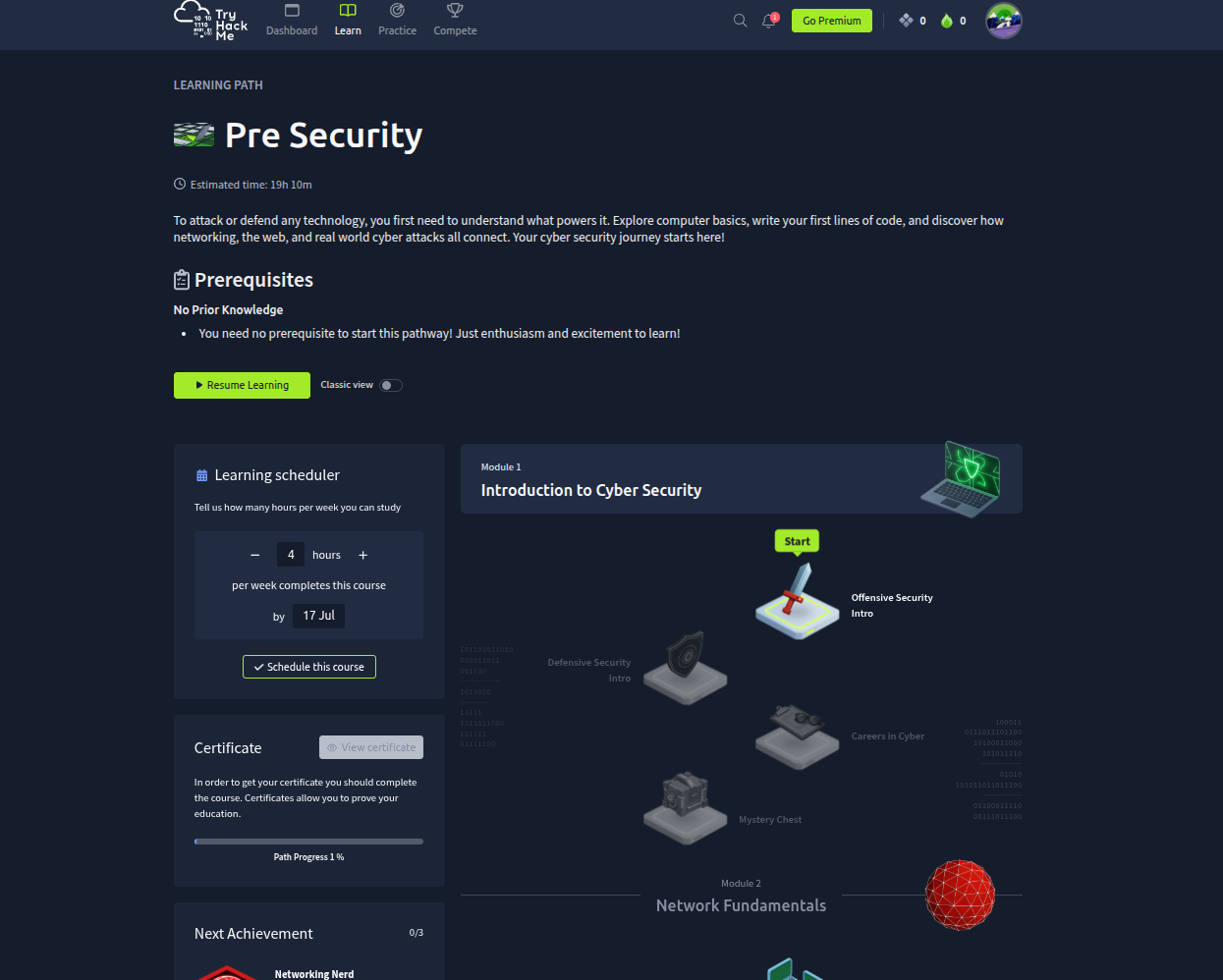
Create a free account and start with the Pre-Security path. It covers networking fundamentals, Linux basics, and web fundamentals in a hands-on format that’s specifically designed for beginners. No prior experience needed.
TryHackMe is the single best starting point in cybersecurity for a beginner in 2026. Before you buy a course, before you set up a VM, before you do anything else - spend a week here.
Step 2 - Kali Linux (When You’re Ready)
Once you’ve completed a few TryHackMe rooms and want to work in a more realistic environment, the next step is setting up Kali Linux - a Linux distribution specifically built for security testing, preloaded with hundreds of security tools.
Run it as a virtual machine using VirtualBox (free) alongside your main operating system. The official Kali documentation covers the setup step by step.
Don’t worry about this until you’re comfortable with TryHackMe. The platform is enough to get started and will keep you busy for weeks.
The Full Roadmap
The stages below build on each other. Cybersecurity is a field where gaps in foundational knowledge compound badly - someone who doesn’t understand networking will struggle with network attacks, someone who doesn’t know Linux will be lost in most security tooling. Work through these in order.
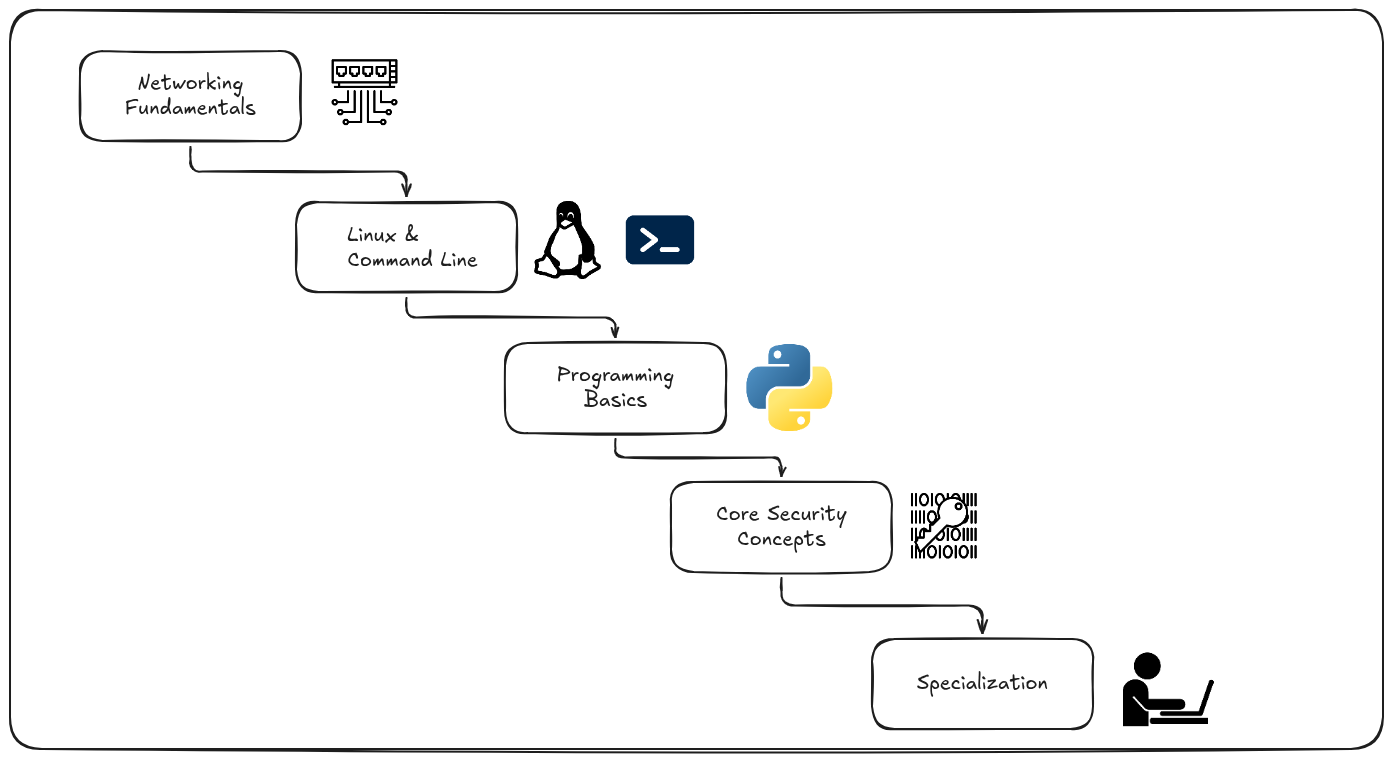
Stage 1 - Networking Fundamentals (6-8 weeks)
Cybersecurity is, at its core, about protecting systems that communicate over networks. You cannot defend or attack something you don’t understand, and networks are the medium through which almost every attack travels.
Learn: the OSI model and what happens at each layer, TCP/IP - how data is addressed, routed, and delivered across networks, DNS - how domain names resolve to IP addresses and why this matters for security, HTTP and HTTPS - how web traffic works, what TLS actually does, and what happens when it’s not present, subnetting - understanding IP address ranges and network segmentation, and firewalls, VPNs, and proxies at a conceptual level.
You don’t need to become a network engineer. You need to understand what’s happening on the wire well enough to know when something is wrong.
You’re ready to move on when: You can explain how an HTTP request travels from a browser to a server and back, and describe what a firewall is actually doing with that traffic.
Stage 2 - Linux & the Command Line (4-6 weeks)
The majority of security tools run on Linux. Servers run Linux. Kali Linux is Linux. If you’re not comfortable in the terminal, you will be blocked at nearly every point in the cybersecurity learning path.
If you’ve already been through the Linux post and the Bash scripting post on this blog, you’ve already started here.
For this stage specifically, go deeper on: file permissions and ownership, user and group management, process management, network commands (netstat, ss, ping, traceroute, curl, wget), and log files - where they live, how to read them, and what they reveal.
You’re ready to move on when: You can navigate a Linux system confidently from the command line, read and interpret log files, and manage permissions without looking anything up.
Stage 3 - Programming Basics (6-8 weeks)
You don’t need to be a software engineer to work in cybersecurity. You do need to be able to read code, write simple scripts, and understand what a piece of code is doing at a functional level.
Python is the language to start with - it’s the dominant scripting language in the security field, used for automating tasks, writing exploit scripts, parsing data, and building simple tools. Learn the fundamentals: variables, data types, conditionals, loops, functions, and file handling. Then focus on the libraries most relevant to security: requests for HTTP interactions, socket for network programming, and subprocess for interacting with the system.
A working understanding of JavaScript is also worth having for web application security - understanding how XSS and injection attacks work requires being able to read the code being injected.
You’re ready to move on when: You can write Python scripts that automate simple tasks - reading files, making HTTP requests, parsing output - without following a tutorial.
Stage 4 - Core Security Concepts (8-12 weeks)
This is the stage where everything comes together. You now understand networks, Linux, and basic programming - this stage teaches you how attackers use that knowledge and how defenders counter it.
Cryptography: how encryption works, the difference between symmetric and asymmetric encryption, hashing and why it matters for password storage, TLS/SSL, and common cryptographic weaknesses.
Authentication and authorization: I can’t emphasize this enough but Authentication and authorization are not the same thing, and the difference matters enough that it’s worth internalizing early. password hashing, multi-factor authentication, session management, OAuth 2.0, JWT - and what goes wrong with each when implemented poorly.
Common attack types: SQL injection, Cross-Site Scripting (XSS), Cross-Site Request Forgery (CSRF), Man-in-the-Middle (MitM) attacks, phishing, and social engineering. Understanding attacks from first principles - not just the names - is what separates professionals from people who can run tools.
The OWASP Top 10: the ten most critical web application security risks, updated regularly, and the baseline for web application security testing globally.
Defensive concepts: firewalls and intrusion detection systems (IDS/IPS), SIEM tools, log analysis, vulnerability scanning, and patch management.
TryHackMe’s SOC Level 1 and Jr Penetration Tester paths cover most of this stage in a hands-on format and are the strongest structured resources for working through these concepts.
You’re ready to move on when: You can identify common vulnerabilities in a web application, explain how they’re exploited and mitigated, and complete beginner-level rooms on TryHackMe independently.
Stage 5 - Specialization (Ongoing)
At this point you have the foundational skills that every cybersecurity professional needs, regardless of path. Now choose your direction.
Revisit the career paths section above and identify where your instincts are pulling you. Start spending more time on that discipline specifically - TryHackMe and Hack The Box both have path-specific learning tracks, and the certifications in the next section are aligned to specific specializations.
The foundation is the same for everyone. What you build on top of it is yours to choose.
Certifications Worth Pursuing
Cybersecurity is one of the few areas in tech where certifications genuinely matter to employers - not as a replacement for hands-on skill, but as a credible signal of it. Here’s the path that makes sense in 2026.
CompTIA Network+ (Optional but Recommended)
Before Security+, Network+ validates your networking fundamentals. It’s not strictly required - Security+ can be attempted without it - but candidates who attempt Security+ without solid networking knowledge struggle. If your networking foundation is shaky after Stage 1 of the roadmap, Network+ is worth pursuing before moving forward.
CompTIA Security+ (First Priority)
Security+ is the most widely recognised entry-level cybersecurity certification globally. It’s vendor-neutral, covers core security concepts across all major domains, and is explicitly required or preferred by a significant portion of entry-level job postings - particularly in the US, where it’s a baseline requirement for many government and defence contractor roles.
Pursue this after Stage 4 of the roadmap. It validates what you’ve learned and opens doors in a way that few other entry-level certifications do.
Certified Ethical Hacker - CEH (Offensive Path)
If you’re heading toward ethical hacking or penetration testing, CEH is the next rung. It’s more offensive in focus than Security+ and validates practical knowledge of attack techniques and tools. It’s widely recognised in corporate and enterprise environments, though the security community’s opinion of its depth relative to cost is mixed. As a career signal, it works. As a learning resource, pair it with hands-on practice.
eJPT - eLearnSecurity Junior Penetration Tester (Offensive Path)
Before OSCP, the eJPT is worth considering as a practical, hands-on entry point for aspiring pen testers. It’s significantly more affordable than OSCP, the exam is practical rather than multiple choice, and it validates that you can actually execute basic penetration testing tasks rather than just describe them.
OSCP - Offensive Security Certified Professional (Advanced, Offensive Path)
OSCP is the gold standard for penetration testing. It’s a 24-hour practical exam where you exploit a set of machines in an isolated network with no hand-holding. It’s difficult, expensive, and respected - hiring managers who see it on a CV take it seriously because they know what passing it actually requires.
This is a Stage 5+ certification, not a beginner one. Pursue it after you’ve completed TryHackMe’s Jr Penetration Tester path, worked through Hack The Box, and are comfortable exploiting systems in lab environments independently.
How to Build Your Portfolio
Cybersecurity portfolios work differently from development portfolios. You can’t push a “hacking project” to GitHub. What you can do is document your learning, demonstrate your thinking, and build a track record of verifiable accomplishment that employers can see.
CTF Write-ups
Capture The Flag (CTF) competitions are structured hacking challenges where you find hidden “flags” by exploiting intentional vulnerabilities. Write-ups are documented explanations of how you solved each challenge - what you found, how you approached it, what tools you used, and what you learned.
Publishing CTF write-ups on a blog or GitHub demonstrates three things simultaneously: technical skill, the ability to think through problems methodically, and communication competence. Even write-ups from beginner-level challenges are worth publishing. Start early.
TryHackMe and Hack The Box Profiles
Both platforms generate public profiles showing completed rooms, machines, and rankings. Your TryHackMe profile is a verifiable record of what you’ve worked through - link it in your CV and LinkedIn. At mid-skill levels, a strong Hack The Box ranking is a genuine signal to hiring managers in the offensive security space.
Home Lab Documentation
If you set up your own lab environment - even a simple one with a few virtual machines - document it. What did you build? What attacks did you practice? What did you learn? A GitHub repository with a well-written lab setup guide and documented experiments demonstrates initiative and technical depth beyond what certifications alone show.
Bug Bounty Reports
Once your skills are at Stage 4 or beyond, platforms like HackerOne and Bugcrowd allow you to find and responsibly disclose vulnerabilities in real systems with permission. Even a single verified bug bounty report is a powerful portfolio piece - it demonstrates that your skills work against real targets, not just intentionally vulnerable lab machines.
Tools You’ll Work With
These are the tools that appear most frequently across cybersecurity disciplines. You’ll pick them up progressively as the roadmap demands them - don’t try to learn them all at once.
- Nmap - the standard network scanner. Used to discover hosts, open ports, and running services on a network. One of the first tools every security professional learns.
- Wireshark - a network packet analyser. Captures and inspects traffic at the packet level. Essential for understanding what’s actually travelling across a network.
- Burp Suite - the industry-standard tool for web application security testing. Intercepts HTTP/S traffic between a browser and a server, allowing you to inspect and modify requests. The Community edition is free.
- Metasploit - a penetration testing framework that provides a library of exploits, payloads, and auxiliary modules. Widely used in pen testing and heavily covered on TryHackMe and Hack The Box. For more information, you can go to the official documentation here.
- John the Ripper / Hashcat - password cracking tools. Used to recover passwords from hashed formats in security assessments.
- Nikto - a web server scanner that checks for common vulnerabilities, misconfigurations, and outdated software.
- Splunk / Microsoft Sentinel - SIEM (Security Information and Event Management) platforms. Used by blue team professionals to aggregate logs, detect anomalies, and investigate incidents.
- OWASP ZAP - a free, open-source web application security scanner. A good alternative to Burp Suite for beginners, particularly for automated scanning.
# command to install the tools
# john the ripper
sudo apt update
sudo apt install john

# hashcat
sudo apt install hashcat

# nikto
sudo apt install nikto

# owasp zap
sudo apt install zaproxy

#if zaproxy isn't available in your repos, then install as a snap
sudo snap install zaproxy --classic

# splunk
wget -O splunk.deb "https://download.splunk.com/products/splunk/releases/latest/linux/splunk-latest-linux-amd64.deb"
sudo dpkg -i splunk.deb
Quick Note: These commands are only needed when your OS is a standard Ubuntu/Debian setup. If you dive deep into cybersecurity and install Kali Linux as your OS, then you already have all these tools installed by default.
Resources Worth Your Time
Platforms
- TryHackMe - the best starting point in cybersecurity. Browser-based, structured learning paths, beginner-friendly. Start with the Pre-Security path.
- Hack The Box - more challenging than TryHackMe, closer to real-world scenarios. Move here after completing TryHackMe’s beginner paths.
Networking
- Professor Messer’s Network+ - free, high quality video course covering networking fundamentals in depth. The best free resource for the networking stage.
Python for Security
- Automate the Boring Stuff with Python - free, practical, and directly applicable to the scripting tasks that come up in security work.
Web Application Security
- OWASP Top 10 - the authoritative reference for web application security risks. Read it. Understand every item on the list.
- PortSwigger Web Security Academy - free, hands-on web security training from the makers of Burp Suite. Covers every major web vulnerability category with practical labs. Exceptional quality.
Certifications
- CompTIA Security+ - official certification page with exam objectives. Use the objectives as a study guide regardless of which study materials you choose.
- OSCP - Offensive Security - official page for the gold standard pen testing certification.
Common Mistakes
-
Skipping networking fundamentals: This is the most common reason beginners stall. Cybersecurity tools make more sense, attacks are easier to understand, and defensive concepts click faster when you have a solid networking foundation. There are no shortcuts here - networking is the substrate everything else runs on. So make sure you learn everything you can about networking (yes, including subnetting).
-
Jumping straight to tools without understanding: Running Nmap/Metasploit without understanding what they’re doing produces output you can’t interpret and skills you can’t transfer. Tools are a means to understanding, not a replacement for it. Always know what a tool is doing and why before you use it in a real context.
-
Practising on systems you don’t own: This is not a grey area. Accessing computer systems without authorization is illegal in pretty much every jurisdiction, regardless of intent. Use dedicated lab environments - TryHackMe, Hack The Box, your own virtual machines - and never test on systems without explicit written permission. A career in cybersecurity ends fast when it starts with a criminal record.
-
Collecting certifications without hands-on skills: Security+ on a CV with no practical experience behind it is transparent to experienced interviewers. Certifications validate knowledge - they don’t replace the ability to actually do the work. Build your lab, complete TryHackMe paths, and write CTF write-ups alongside your certification prep. The two should reinforce each other.
-
Ignoring the defensive side: Even if your destination is offensive security, understanding how defenders think, what logs they look at, and what detection looks like makes you a better attacker - and a better professional. The best pen testers understand both sides of the wall.
-
Neglecting documentation and communication skills: Cybersecurity professionals write reports, present findings to non-technical stakeholders, and document their work constantly. The ability to communicate what you found and why it matters is as important as the technical skill to find it. Start writing early - blog posts, CTF write-ups, lab documentation - and treat communication as a skill to develop deliberately.
Frequently Asked Questions
No - but cybersecurity is more certification-driven than most other tech disciplines, so certifications do some of the work that degrees do elsewhere. A strong combination of certifications (Security+, CEH or eJPT for offensive roles), hands-on platform experience (TryHackMe, Hack The Box), and a documented portfolio (CTF write-ups, lab work, bug bounty reports) is a genuinely competitive profile in the job market. Degrees help in certain environments - government and large enterprise in particular - but they're not a prerequisite.
Following this roadmap with consistent daily practice, most people reach an entry-level job-ready standard in 12 to 18 months. SOC analyst and GRC roles are typically more accessible at the junior level and can be reached toward the lower end of that range. Penetration testing roles are more competitive and usually require more demonstrable hands-on experience before hiring managers take a junior candidate seriously.
The breadth is what makes it challenging - cybersecurity draws on networking, operating systems, programming, and security concepts simultaneously. Each individual topic is learnable, but the field is wide and the foundational stage takes longer than most beginners expect. The good news is that platforms like TryHackMe make the early stages significantly more accessible than they were even five years ago. The difficulty spikes when you move into specialization - particularly offensive security - but by that point the foundation makes the harder concepts manageable.
You can get started without coding, and some cybersecurity paths - particularly GRC - require relatively little programming. But for most paths, especially anything on the offensive side or in security engineering, basic Python scripting becomes necessary fairly quickly. The roadmap above includes a programming stage for exactly this reason. You don't need to be a developer - you need to be able to read code, write simple scripts, and understand what a program is doing at a functional level.
Cybersecurity is the broader field - it includes everything from network defence and incident response to GRC and security engineering. Ethical hacking (also called penetration testing) is one specific discipline within cybersecurity: the practice of attacking systems with permission to find vulnerabilities before malicious actors do. All ethical hackers work in cybersecurity, but not all cybersecurity professionals are ethical hackers. If ethical hacking is specifically where you want to go, the next post on this blog is written for you.
Security engineering and penetration testing tend to command the highest compensation at senior levels, primarily because both require deep technical skill that takes years to develop. Cloud security specialists have also seen strong salary growth as cloud adoption has accelerated. GRC roles tend to pay less at the junior and mid levels but offer strong stability and clear progression into senior advisory and executive roles. The path that pays the most long-term is the one you go deepest on - specialization and genuine expertise always outpay breadth at the senior level.
Where to Go From Here
You’ve got the full picture: what cybersecurity is and why it matters, every major career path in the field, the job market and what it pays, a hands-on lab to start with today, a complete roadmap from networking fundamentals to specialization, the certifications worth pursuing, and how to build a portfolio that employers can actually evaluate.
The next step is to open TryHackMe, create a free account, and start the Pre-Security path. Not tomorrow. Today. The roadmap above tells you where you’re going - TryHackMe is where you take the first step.
If you’re not set up on Linux yet, the Windows to Linux guide covers everything you need - and since Linux is non-negotiable in cybersecurity, it’s worth doing properly. The Bash scripting post covers the command line skills that Stage 2 of this roadmap builds on.
And if ethical hacking is specifically where you’re headed - the offensive side, the penetration testing, the finding-vulnerabilities-before-attackers-do work - the next post goes deep on exactly that. Stay tuned.
For questions, progress updates, or just to share what you’re working on - the community links are in the footer.